Sky Notes for April 2026
Brian Kelly
Director of Observations
Dundee Astronomical Society
From our Director of Observations, Brian Kelly.
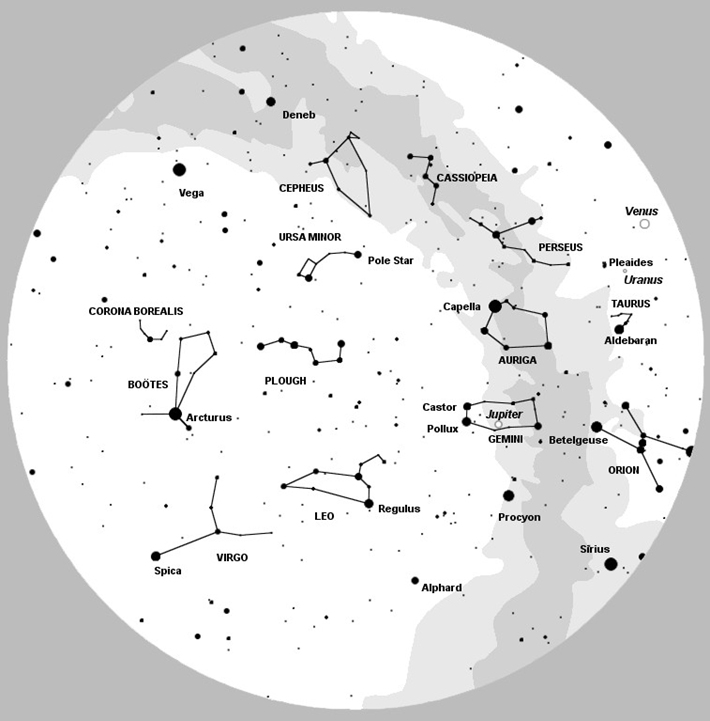
THE SKY AT 9 PM GMT IN MID-APRIL 2026
The map above shows the night sky as it will appear from central Scotland at the time and date shown. The point in the sky directly overhead is at the centre of the map; the outer circle is the horizon with the cardinal compass points in the direction shown.
The map shows the brighter stars that are visible to the unaided eye. Some of the more distinctive constellations are outlined.
North
West
East
The Moon
The Planets
The Sun
The Stars
South
The sunrise, sunset and twilight times given here are for Dundee but generally apply across central Scotland.
April 1st sunrise 6.42 am BST sunset 7.50 pm BST
April 15th sunrise 6.05 am BST sunset 8.19 pmBST
April 30th sunrise 5.28 am BST sunset 8.51 pmBST
In mid-April, the sky is reasonably dark between 10.00 pm and 4.30 am BST.
The Sun travels through the constellation of Pisces for the first half of April, and then crosses into Aries from Sunday 19th onwards.
April’s Full Moon falls in the early hours of the morning of Thursday 2nd. The Moon rises in the east shortly before sunset on Wednesday 1st, and sets again in the west just before sunrise on the 2nd.
On the evening of Thursday 2nd the broad waning gibbous Moon lies just 2º to the lower right of the white star Spica in Virgo.
Last Quarter is on the morning of Friday April 10th. The half-Moon rises less than two hours before the Sun, and is very low in the east-south-east at sunrise.
The waning crescent Moon may be spotted low in the south-east at dawn for the following few mornings after this, before it becomes lost in the glow of the rising Sun.
New Moon is on Friday April 17th, and the very narrow waxing crescent may be spotted low in the west- north-west after sunset on Saturday 18th, when it will lie 8º to the lower right of the bright planet Venus. On the following evening, Sunday 19th, the young Moon will appear a similar distance directly above Venus.
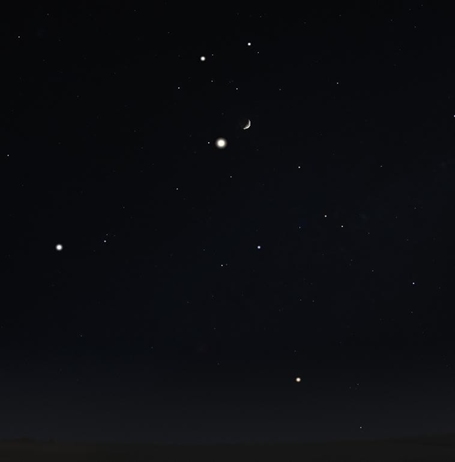
On the evening of Wednesday 22nd the wide crescent Moon will sit just over 3º to upper right of the planet Jupiter.
First Quarter is on Friday April 24th, when the half-illuminated Moon will shine high in the south-west in the evening twilight.
On the night of Saturday 25th, the waxing gibbous Moon will lie less than 2º to the lower right of the bright star Regulus in the constellation of Leo. On Wednesday 29th the Moon – just two days from Full – will again appear to the right of Spica.
Mercury is a morning object during April, reaching its greatest elongation west of the Sun on Friday 3rd. However it rises only a short time before the Sun throughout this period, and therefore will remain hidden in the bright dawn twilight.
Venus is a very bright ‘Evening Star’ this month, shining at magnitude -3.9 above the western horizon after sunset. It sets around two hours after the Sun at the start of April, and almost three hours later by the month’s end.
Mars is also rising just ahead of the Sun and, like Mercury, will be invisible in the twilight glow.
Jupiter is high in the south-west as the sky grows dark, shining steadily at magnitude -2.1 among the stars of Gemini, to the lower right of Castor and Pollux.
Saturn is slowly emerging into the morning sky after passing behind the Sun at the end of March, but throughout April it too will be lost in the glow of the dawn sky.
Uranus lies about 5º below the Pleiades star cluster and by mid-month is setting before midnight BST.
Neptune is also rising just ahead of the Sun this month and will not be visible.
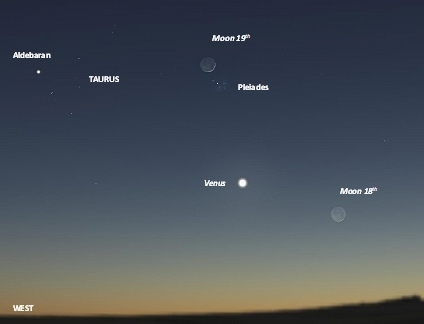
The crescent Moon and Venus on the evenings of Saturday 18th and Sunday 19th April, looking west at 9.30 pm BST (an hour after sunset).
Both images ©Stellarium
CASTOR
POLLUX
MOON
JUPITER
GEMINI
PROCYON
WEST
On the evening of Wednesday April
22nd
, the crescent Moon will sit just
to the upper right of the planet
Jupiter, and below the ‘Twin’ stars of
Gemini, Castor and Pollux. View
looking west at 11.00 pm BST.
As the sky grows dark on April evenings, the winter constellations are low in the western sky while the stars of spring stand high in the south and east.
Orion is still just visible above the western horizon, slowly sinking feet-first into the twilight. To the right of Orion is the V-shaped head of Taurus the Bull and little star cluster of the Pleiades or Seven Sisters.
Brilliant Sirius, the ‘Dog Star’, twinkles strongly to the lower left of Orion.
Above Taurus are the constellations of Perseus and Auriga, with Gemini the Twins to the left. A chain of bright stars, running from Aldebaran in Taurus up through Capella, Castor and Pollux then down to Procyon and Sirius, seems to encircle Orion as he sets in the south-west.
Round in the south is the prominent spring group, Leo the Lion. Leo’s head is represented by a hook of
stars rather like a backwards ‘?’, popularly known as the ‘Sickle’, with the bright white star Regulus at the bottom. To the lower right of Regulus is another bright star, yellow in colour. This is Alphard, brightest star in the constellation of Hydra; Alphard lies in a barren region of sky, and its name, appropriately enough, means ‘the Solitary One’.
To the lower left of Leo is another member of the zodiac, Virgo. The main stars make up a pattern resembling a ‘Y’, with its brightest star, Spica, at the tail. High in the east is the orange star Arcturus, brightest star in the northern sky, which makes a striking colour contrast with Spica and Regulus. Arcturus belongs to the kite-shaped constellation of Boötes the Herdsman; to the left is the semi-circle of stars forming the distinctive pattern of Corona Borealis, the Northern Crown.
Almost directly overhead on April evenings is the familiar pattern of the Plough or Big Dipper. The two stars at the end of the ‘bowl’ of the Dipper are called the ‘Pointers’, and they show the way to the Pole Star. The curve of the handle of the Plough or Dipper leads round first to Arcturus then on to Spica.
Low in the north are the ‘W’ shape of Cassiopeia, and her rather fainter husband Cepheus. The bright stars Vega and Deneb are low in the north-east.
On spring evenings the Milky Way curves low across the sky from south-west to north-east, and is easily hidden by streetlights or haze near the horizon.